Uniform list
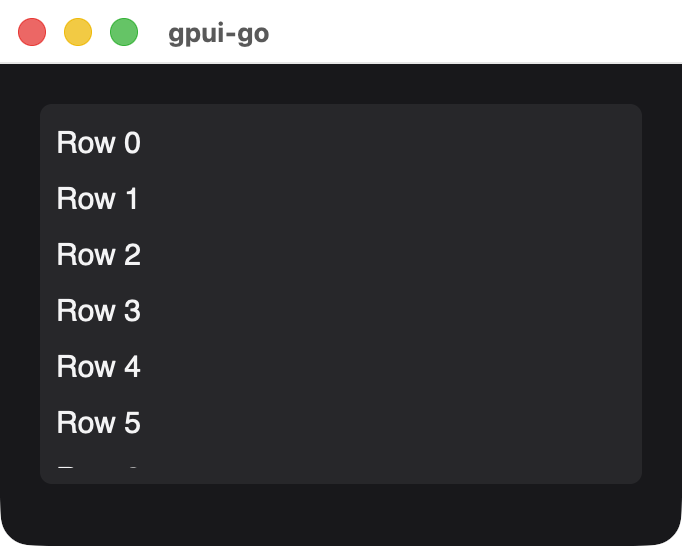
A scrolling list whose rows all have the same height. Only visible rows are laid out and painted.
rows := make([]*scene.Node, 0, 1000)
for i := range 1000 {
	// Each row needs its own ID, and so does every element inside it.
	rows = append(rows, scene.Text(uint64(100+i), fmt.Sprintf("Row %d", i)))
}

list := scene.UniformList(50, 28, rows...).Style(&scene.Style{
	Width:  scene.Percent(100),
	Height: scene.Pixels(320),
})
Signature
func UniformList(id uint64, rowHeight float32, rows ...*Node) *Node| Parameter | Description |
|---|---|
id | Stable nonzero element ID, also the target for ScrollTo |
rowHeight | Height of every row in logical pixels, from 1 to 16384 |
rows | Row nodes, each copied. A nil row panics |
The list fills its box, so give it a definite height. Each row is as wide as the list and exactly rowHeight tall, and content past that height is clipped.
Scrolling from Go
if err := window.ScrollTo(ctx, 50, 999); err != nil {
	return err
}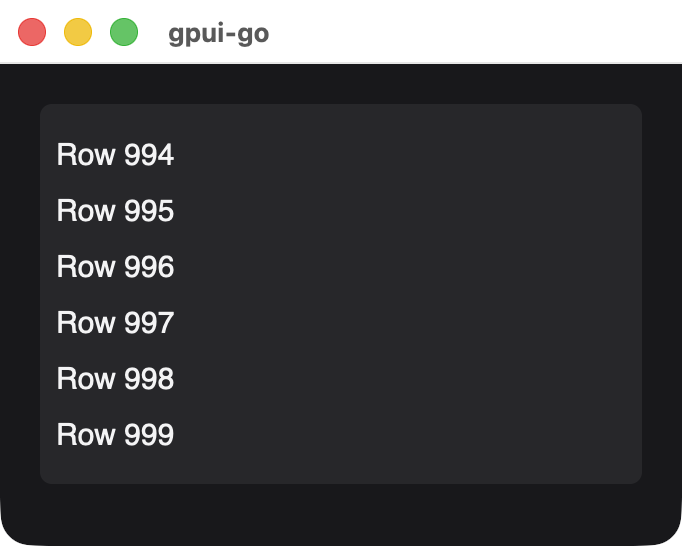
The same list after ScrollTo(ctx, 50, 999).
Window.ScrollTo(ctx, element, item) scrolls so that the zero-based row is visible. It returns an error if the element is not a uniform list or the row is out of range. Scroll position is native state that persists across snapshots.
Limits
Virtualization covers layout and painting, not data transfer. Go sends every row in every snapshot, and rows and their contents count toward the 10,000-element and 4 MiB limits. Paged and variable-height lists are not available.
Available in other APIs
Uniform list is only available through scene. For keyed rows that are not virtualized, use ui.For.